On this page
Having a file on your phone is not the same as owning it. You can download a video in seconds and still have no right to post it anywhere. Most trouble people get into comes from mixing those two up.
This guide explains the rules in plain words. It is general information, not legal advice, and the details differ from country to country. When something matters, such as using a clip in an ad, ask the owner or a lawyer.
Who owns a video?
Whoever made it, from the moment it was made. In most countries copyright is automatic: no form, no symbol, no registration. A TikTok filmed this morning is protected the same way a film from a big studio is.
Posting a video publicly does not give it away. Public means anyone may watch it on the platform. It does not mean anyone may copy it, edit it or post it again.
Downloading creates a copy. Whether that copy is fine depends on what it is and what you do with it.
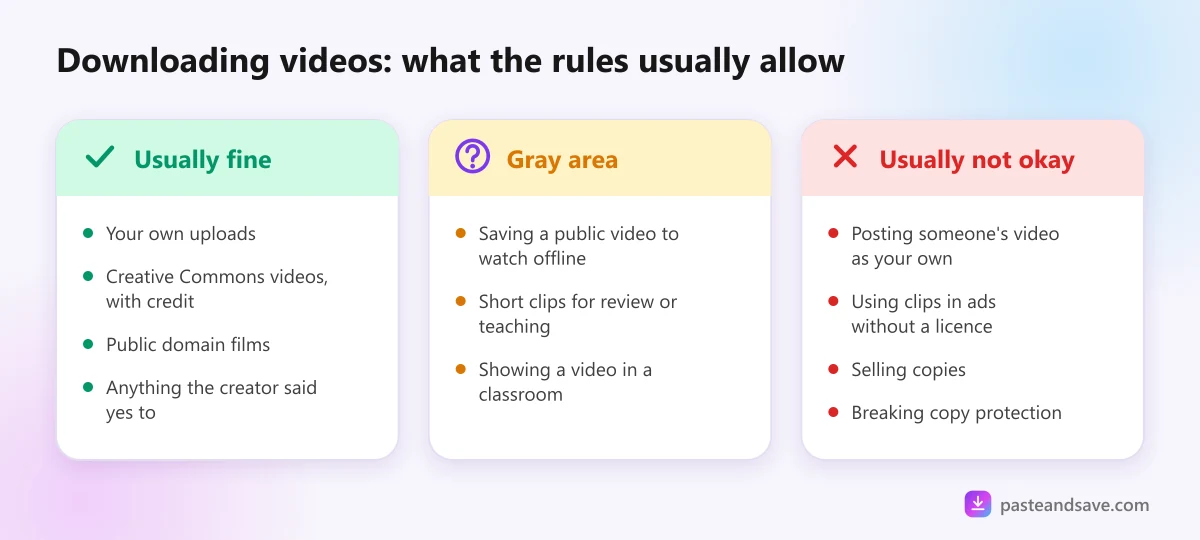
Usually fine
- Your own videos. Downloading what you uploaded, for a backup or to post on another app, is your right.
- Creative Commons videos. The creator chose a licence that allows copying. YouTube lets creators mark videos this way, and sites like Wikimedia Commons are full of them. Follow the licence, which usually means giving credit.
- Public domain material. Very old films and many government videos have no copyright left, or never had any.
- Videos you have permission for. A message from the creator saying yes, kept somewhere safe, settles it.
- Videos the platform lets you save. When TikTok shows a Save video button, the creator allowed downloads.
Gray areas
- Saving a public video to watch offline. Some countries allow private copies for personal use, others don't, and most platforms' terms say no. It is a common thing to do, but it is not automatically allowed.
- Short clips for review, commentary, teaching or news. In the United States this may be fair use, which is judged case by case. Other countries have similar ideas, often called fair dealing, with narrower rules.
- Showing a video in a classroom. Many countries have education exceptions, with conditions on how and where.
Usually not okay
- Posting someone else's video on your own account, with or without credit.
- Using clips in ads, paid promotions or monetized videos without a licence.
- Selling copies, or putting them behind a paywall.
- Getting around copy protection on paid services such as Netflix, Disney+ or Spotify. In many countries, including the United States and the EU, breaking that protection is against the law on its own. PasteAndSave does not do it and never will.
Platform rules are a separate layer
Every platform has terms of service, and they are a contract between you and the platform, separate from copyright law. YouTube's terms, for example, don't allow downloading except through YouTube's own features or with permission. Breaking a platform's terms can cost you your account even when no copyright law was broken.
Credit is not permission
"Credit to the owner" and "no copyright intended" under a reposted video don't make the repost legal. They tell everyone you knew it wasn't yours. Credit is good manners on top of permission, never a replacement for it.
How to ask for permission
Asking takes two minutes, and creators say yes more often than people expect. A message like this works:
Hi, I loved your video about [topic]. Could I share it on my page [name], with your name and a link back to you? I won't edit it or use it in ads. Thank you!
Keep the reply. A screenshot of a clear yes is your proof later.
Where PasteAndSave fits in
PasteAndSave is a tool, like a screen recorder or a browser. It only reaches videos anyone could watch without logging in, and it never touches copy protected streams. What you do with the file is your decision and your responsibility, which is why our Terms of Service ask you to download only what you have the right to use.
Next lesson
One lesson left. Are Online Video Downloaders Safe? shows how to spot a bad download site in thirty seconds, and what a good one does with your data.
Advertisement
Questions people ask
Is it illegal to download YouTube videos for personal use?+
It depends on your country. YouTube's terms only allow downloads through its own download button or with permission, and copyright law decides what you may do with the copy. Saving your own uploads or Creative Commons videos is generally fine. Reposting someone else's video is not.
Does giving credit make it legal to repost a video?+
No. Credit is polite, but it is not permission. Writing the creator's name or 'no copyright intended' under a repost does not give you the right to use their work. Only the owner, or a licence they chose, can do that.
Can I download Creative Commons videos?+
Yes. Creative Commons videos are shared on purpose under a licence that allows copying. Read which licence it is: most ask you to credit the creator, and some forbid commercial use or edits.
Is it legal to download TikTok videos?+
Saving a TikTok for yourself is treated very differently from reposting it. Creators can allow or block TikTok's own Save button, which tells you their wishes. Reusing someone's TikTok in your own posts or ads needs their permission.